

Insights: Alex Seton on stone, making and material discovery

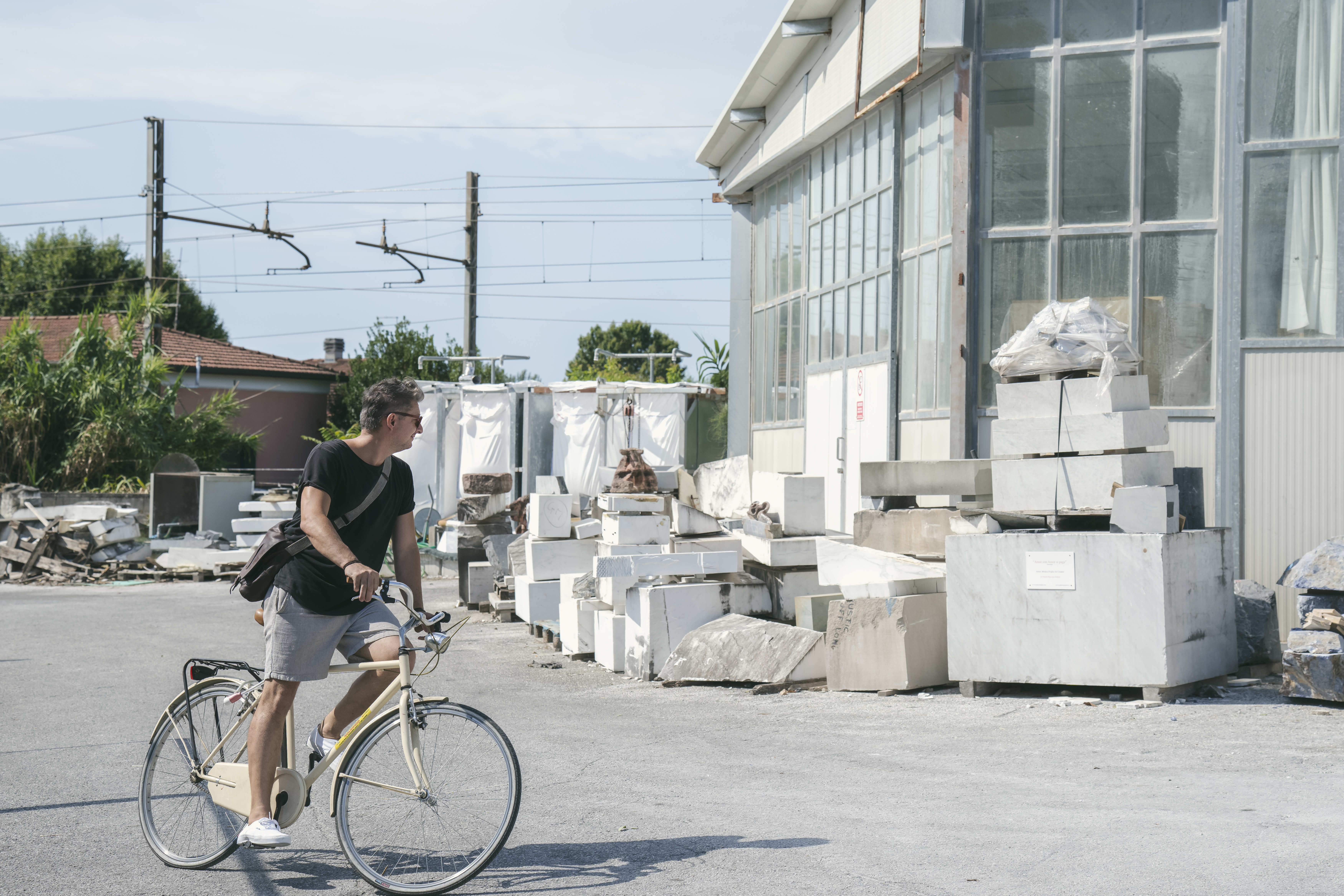
Regular Stone Specialist readers will already be familiar with the work of Rebecca Jak. Following her co-curation of the insightful What Lasts Doesn’t Always Hold Shape exhibition at No.1 Poultry earlier this year, we invited her to interview Australian sculptor Alex Seton during the recent Frieze London exhibition. In this Insights article, they discuss his relationship with stone, the evolution of his practice, and their thoughts on how stone might offer a wider conversation about the future of making, technology and material applications.
“In his latest body of work The Sosie Series, Australian stone sculptor Alex Seton presents two sculptures whose forms mirror one another on rotating timber plinths at Frieze London 2026. Carved from Rosa Portugale and Verde Ming marble, together the pair explore the uncanny relationship between the self and our digital doppelganger. The series draws on the growing dissonance between our physical and online identities, capturing how our digital reflections take on lives of their own, increasingly beyond our control.
Image: Nicola Gnesi Studio
This body of work explores contemporary concerns regarding the loss of control inherent in our relationship to online identities, whilst revealing the lessons stone has imparted through Seton’s lifelong entanglement with the material. Working with stone requires a unique push and pull between mastery and relinquishing control upon which Seton comments:
Image: Nicola Gnesi Studio
Being a natural material, discovery is crucial. Every time you chip away at stone, there might be a different layer underneath, a different character line, a different flaw or unexpected colour. Stone carving is a reductive medium. It is a series of choices, and you can’t second guess them. If you make decisions quickly and move on, you begin going somewhere, you go on a journey. Risk more, gain more is what I say. Ultimately when working with stone, you have to relinquish a sense of imposition.
Image: Nicola Gnesi Studio
What became clear throughout my interview with Seton, is that the pieces exhibited at Frieze London 2026 were a punctuation mark within an expansive career. The path has undulated, taken turns, pushed back and resulted in what I would describe as a reciprocal relationship between maker and material. From a childhood growing up near a quarry, to his monumental installation Dark Heart for the 2014 Adelaide Biennal at The Art Gallery of South Australia, Seton explains how his relationship to the material has developed:
At the beginning, carving stone felt familiar as I grew up around the material. When I started carving in earnest after art school, I wanted to prove myself and demonstrate my skill. In the early years, I chose materials that best suited the subject of my work. I chose durable, consistent stones. Later, when my work became more political, I began to embrace the marble’s monumental history and all that it implies. In socially engaged work, I also recognised the sincerity that comes with the act of labour. For The Sosie Series, I was inspired by the material itself. The pink Portuguese marble has a mottled quality, a fatness and a fleshiness. It has these peppery lines and almost bruised-like veins. Before, I often worked in reverse. I had an idea and went looking for the stone. What I realised over time is that one will always inform the other. For me, what has changed is the balance.
Image: Mark Pokorny
Buildings have a peculiar way of making stone appear mobilised by time. We encounter stone as facade elements and polished floor tiles, seemingly immune to the passing of time. Yet every piece of stone arrives with a history that precedes its life within a building or sculpture. Somewhere along the journey, the mountain becomes a material, and the material becomes a product. What is lost in that transformation? What is found?
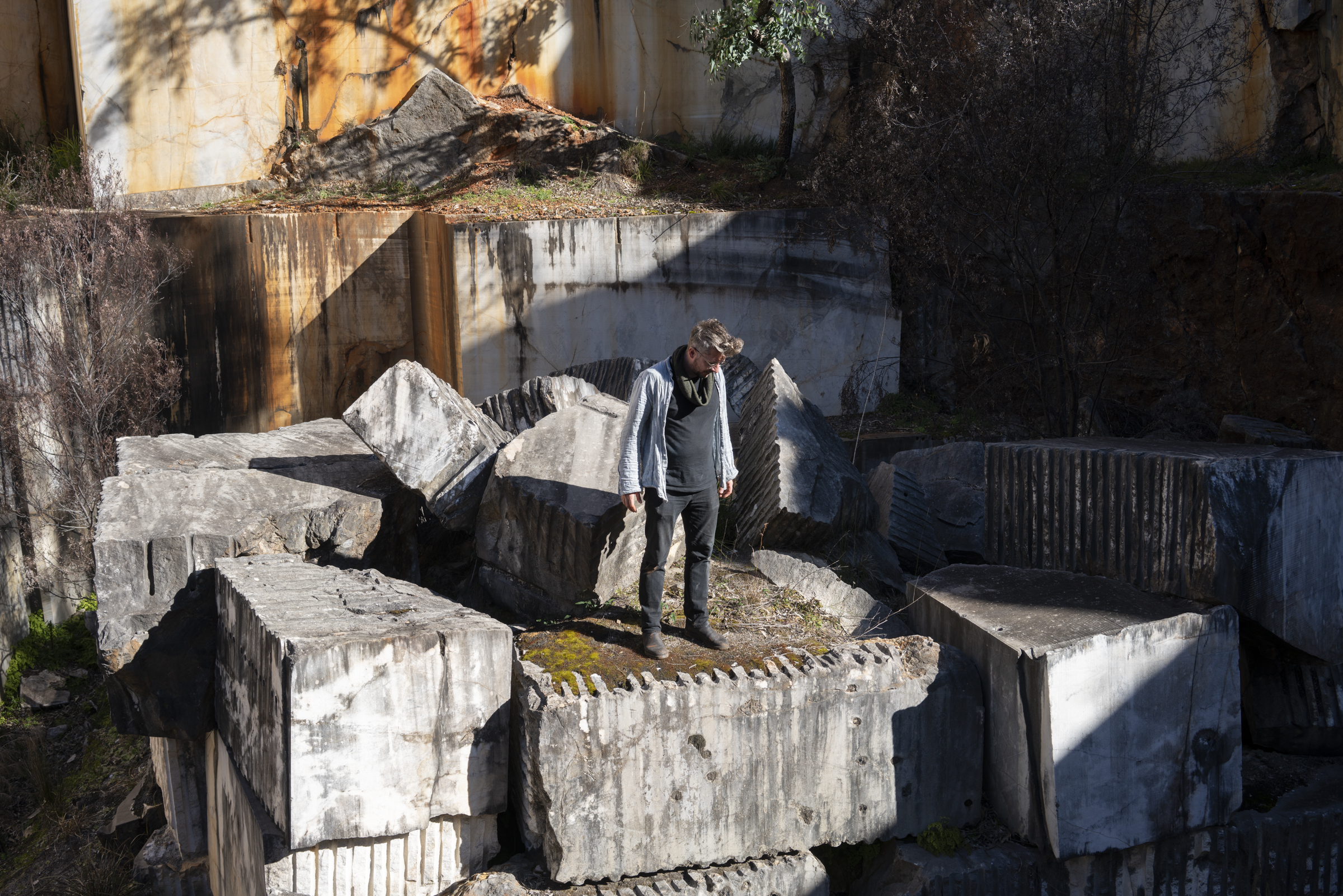
Image: Vasili Vasileiadis
As professionals within the construction industry, we often celebrate stone’s capacity to endure. Durability alone is not the only measure of this material’s sustainability. There is also the question of how much of a material we use, and what becomes of what we leave behind. A block of marble might become a sculpture or be cut into building tiles, but its story need not end with this seemingly finished form. Rather than viewing offcuts, dust and rubble as waste, Seton sees this as an exciting opportunity:
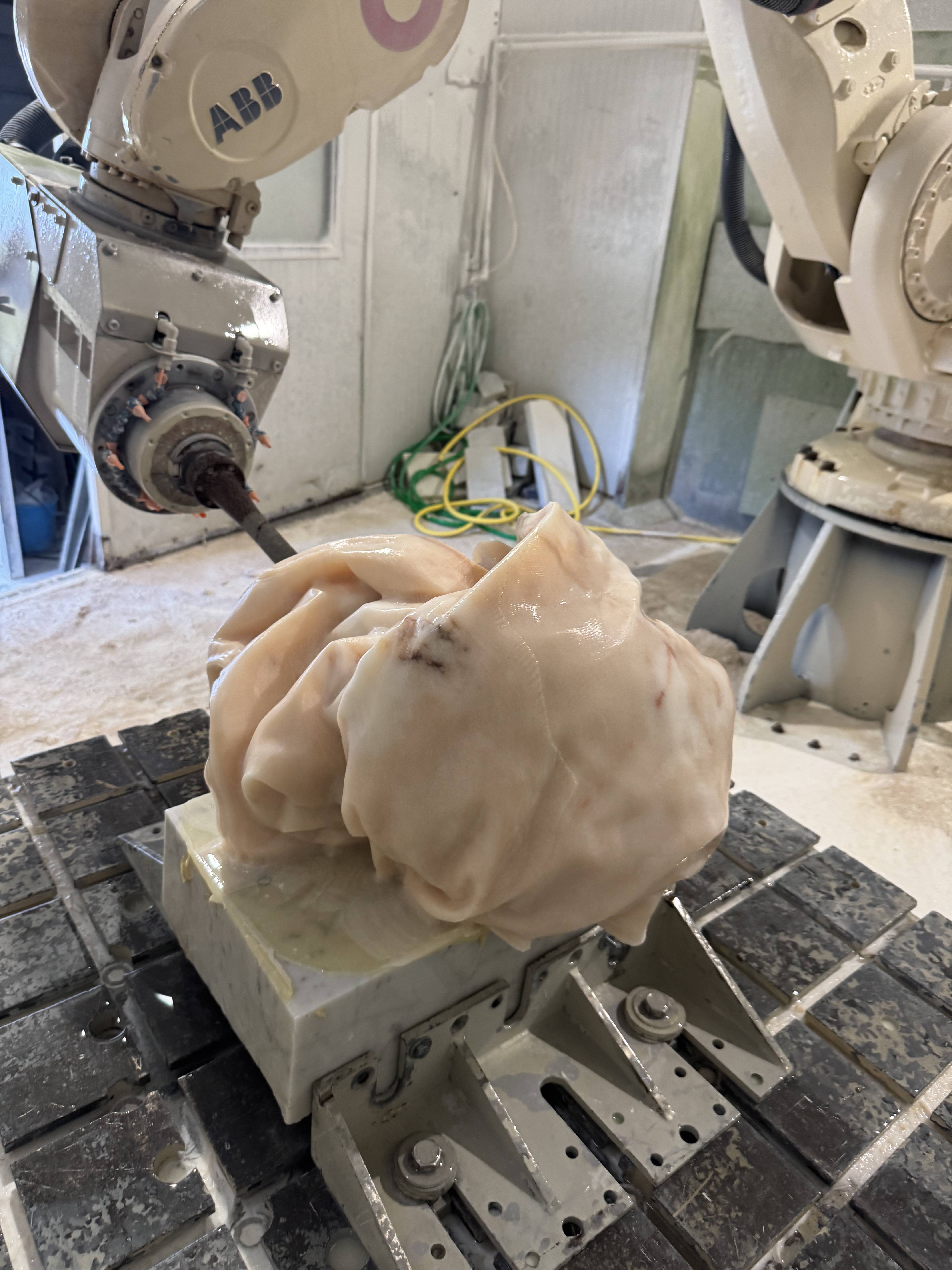
Image: Alex Seton
The key for me is to do it once and do it well. This means using 100% of the material, acknowledging stone as a material with deep geological time written into it. I used to pay a service to take away my rubble for use in road tarmac. It was a useful solution, but then the material started finding other lives. A group of students I was guest-lecturing at the University of Technology Sydney came to me and asked if they could use my marble dust and rubble in breeze blocks. They introduced me to The Natural Brick company, which makes terrazzo tiles and later began using the waste from my studio. They now make different tile series using the material from each body of work, sometimes in a new colour, or mixing it with an earlier series to create a new combination.
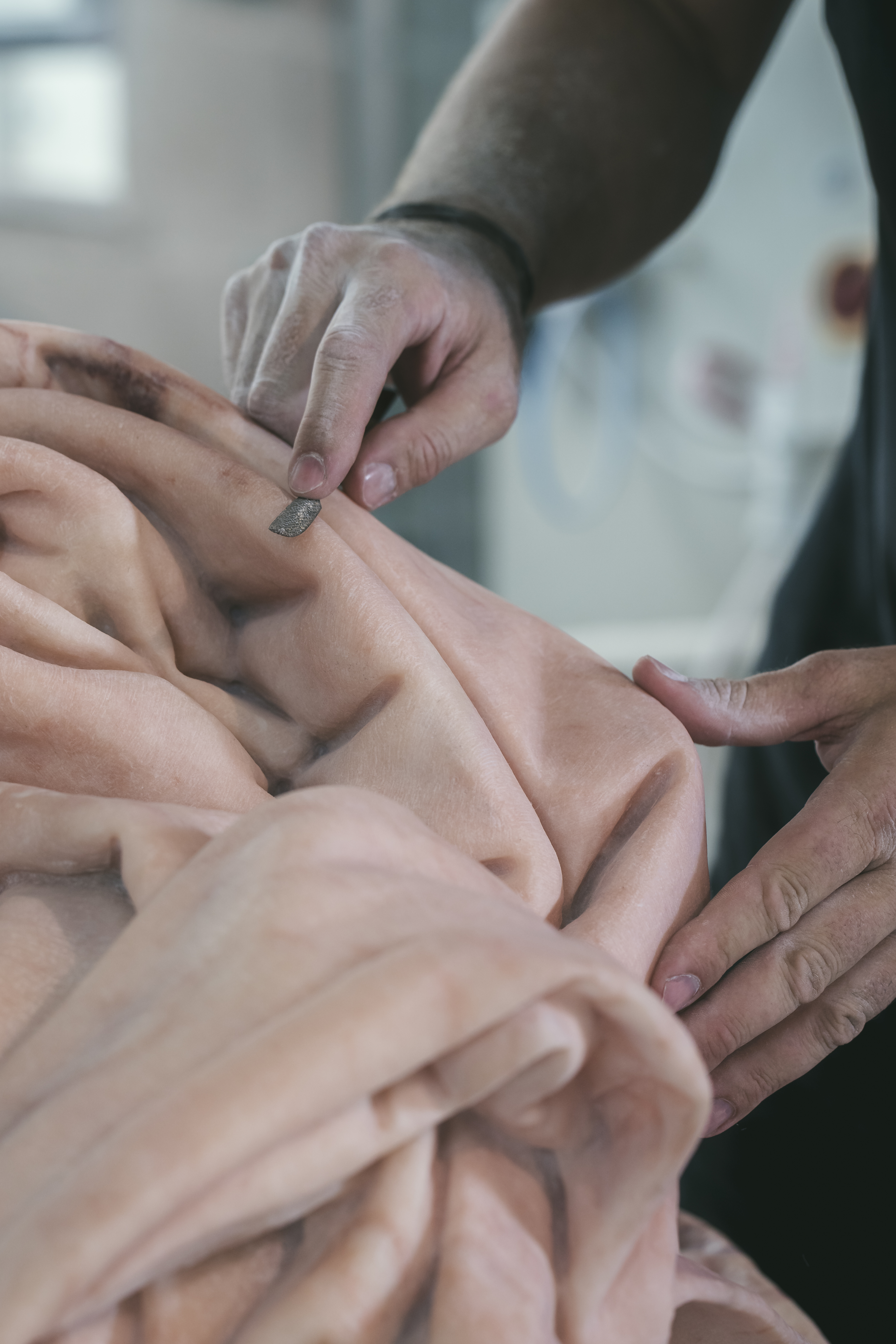
Image: Lorenzo Montanello
In architecture, as in sculpture, the tools through which we give form to an idea are never entirely neutral. They shape not only what we can produce, but how we understand the act of production itself. As digital technologies become increasingly embedded in design and fabrication, the conversation often collapses into ultimatums: handmade or machine-made, craft or computation, authorship or automation. Seton offers a perspective that is neither, and rather is a perspective on the value of a work exceeding the gesture of the hand alone, favouring the all-rounded knowledge of the maker.
You’ll notice there is a tendency towards the handmade, perhaps partly because of people’s concerns about technology. After decades of carving, I’m interested in exploring technology as a tool. Getting people to understand the difference between using technology as a tool and allowing it to override the judgement of the maker is an important distinction to me. I am currently developing new work in which I take an original carving of mine, scan it, slice it down the middle and mirror it against itself, almost like a cell dividing. The sculpture becomes more iterative and abstract as it is divided and mirrored. The original hand-carved forms are re-carved and reiterated using technology and then finished by hand again. I want to bring nuance to this conversation around technology being a tool, and I’m interested in using it to gain new insight and achieve greater technical complexity and scale in my practice.
Image: Nicola Gnesi Studio
Seton’s practice reminds us that stone’s permanence is inseparable from its capacity for reinvention and reinterpretation. As the stone industry within construction explores new technologies, more considered uses of materials and possibilities for reuse, there is much to be gained by looking beyond its own boundaries. The exchange between art and architecture offers a space for new ways of thinking, working and making. By bringing different disciplines into conversation with one another, we can allow the most familiar of materials like stone to keep revealing themselves anew.”
Alex Seton is represented by Sullivan+Strumpf. You can explore more of his practice and work here.
Rebecca Jak is an independent material researcher and curator. You can discover more about her work here.