

Interview: Adam Draper, Draper Studio

As Adam Draper, founder of Draper Studio, points out, all conversations start with a hello.
As an architect who specialises in residential projects with problematic restrictions, his warm and welcoming approach is well-suited. Having started his career with Groupwork, where he completed his qualification, he has since worked for Stein Architects and then Architecture for London, before setting up his own studio in 2019. Having met him at the recent Stone Collective book launch, I was keen to find out more about the practice, and what homeowners can expect when engaging with the studio.

JB: I’m intrigued to hear more about your process, not least in how you build close working relationships with your clients, who are generally the direct owners of the property in question.
AD: Clients usually make the first approach by phone. We discuss the project aspirations, their concerns, their budget and what working with an architect looks like - for many this is their first time commission, but sometimes clients come having wished they’d used one before.
For a fee, I then conduct a design session at the property, to meet and go through some initial ideas, clarify specific legal frameworks and develop each others’ understanding of the project ahead. It’s often helpful for the client to witness live layout and perspective sketches to illustrate our discussion as it builds clarity quickly. This is followed up with formalised sketch layouts of what we discussed and a fee proposal for the services, timescales and next steps.
Image Credit: Peter Molloy
JB: Do you find there are commonalities between the types of people who approach you?
AD: The clients who commission Draper Studio’s projects do so because they have a challenging consent or series of spatial configurations to overcome. They have a desire for more than “just” a rear extension and want to pursue something that is architecturally led. Working with an architect who specialises in homes means they feel reassured that their home alterations are being guided through all the challenges, yet insulated from the pitfalls and the outcome. Often, what they and their loved ones like is that they would have been unable to conceive it themselves.
JB: Thankfully, conversations - and actions - around retrofit appear to be on the rise, and I know it’s a priority for the studio. What drives your thinking here, and how receptive are your clients to the idea of restoring rather than removing?
AD: Of all refurbishment work activities, whether reconfiguring, remodelling, extending or refinishing, restoration is something that can strike up much debate. I don’t offer any position, but I approach things with this mindset:
Restoring building components is an easily understood example - it’s the leaky sash window in a conservation area with Article 4 restrictions.
It has a linear outcome: problem + resolution = cost + time. This is level 1 restoration. But restoration is not slavery to an idea. Neither should restoration be a cost burden - remember, all buildings are costly. Value, its cousin, when seen in its many forms, is scalar here.
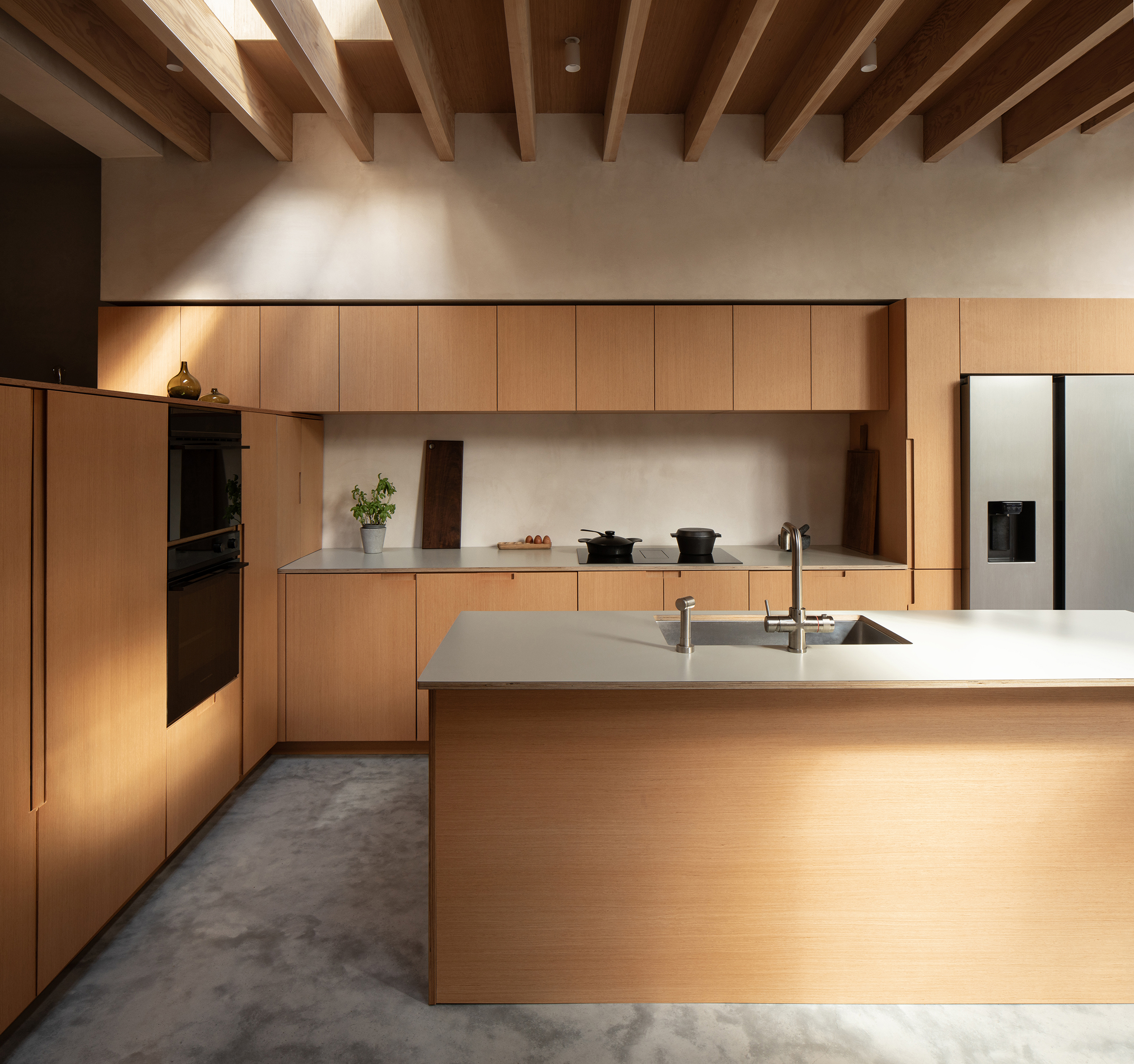
Image Credit: Peter Molloy
With this in mind, we begin to move towards Level 2:
At an architectural level, restoration presents a bigger opportunity. Restoration is rarely just about the faithful replication of a cornice that's been overpainted 4 times. Restoration is more about the stitching together of the series of interrelated and sequential elements, spatially. Level 2 asks these questions: How do we work with the building, as opposed to against it? By extension, how do we highlight any special characteristics of the host building in a design that makes it distinct? Can we realise volume as well as area? How do we investigate carefully and put the right strategy in place to mitigate excess or the unnecessary? If we add or remove, does it restore, too? Does the overall cohere? If it does, is that a success?
JB: Hearing this, I imagine there is a lot of push and pull within these conversations, as well as with the physical building itself?
AD: Often by adopting the approach of working with a building, rather than against it, will provide significant cost and value benefits. In terms of Retrofit, when adopting ‘fabric first principles’ such as adding appropriate insulation, this requires an onward conversation with the client’s needs and budget throughout key project milestones. Often, that same overpainted cornice, kept in situ, will restrict the extensive thermal performance upgrades to a wall they might want. There’s balance, and often on a case-by-case basis;, it's always good to have a clear brief from the client on where they want to take remediation works. For instance, if your original plaster is blown, it may be time to consider replacing it with lime plaster and wood fibre insulation, because you’ll likely have to budget for at least one of those trade installs.
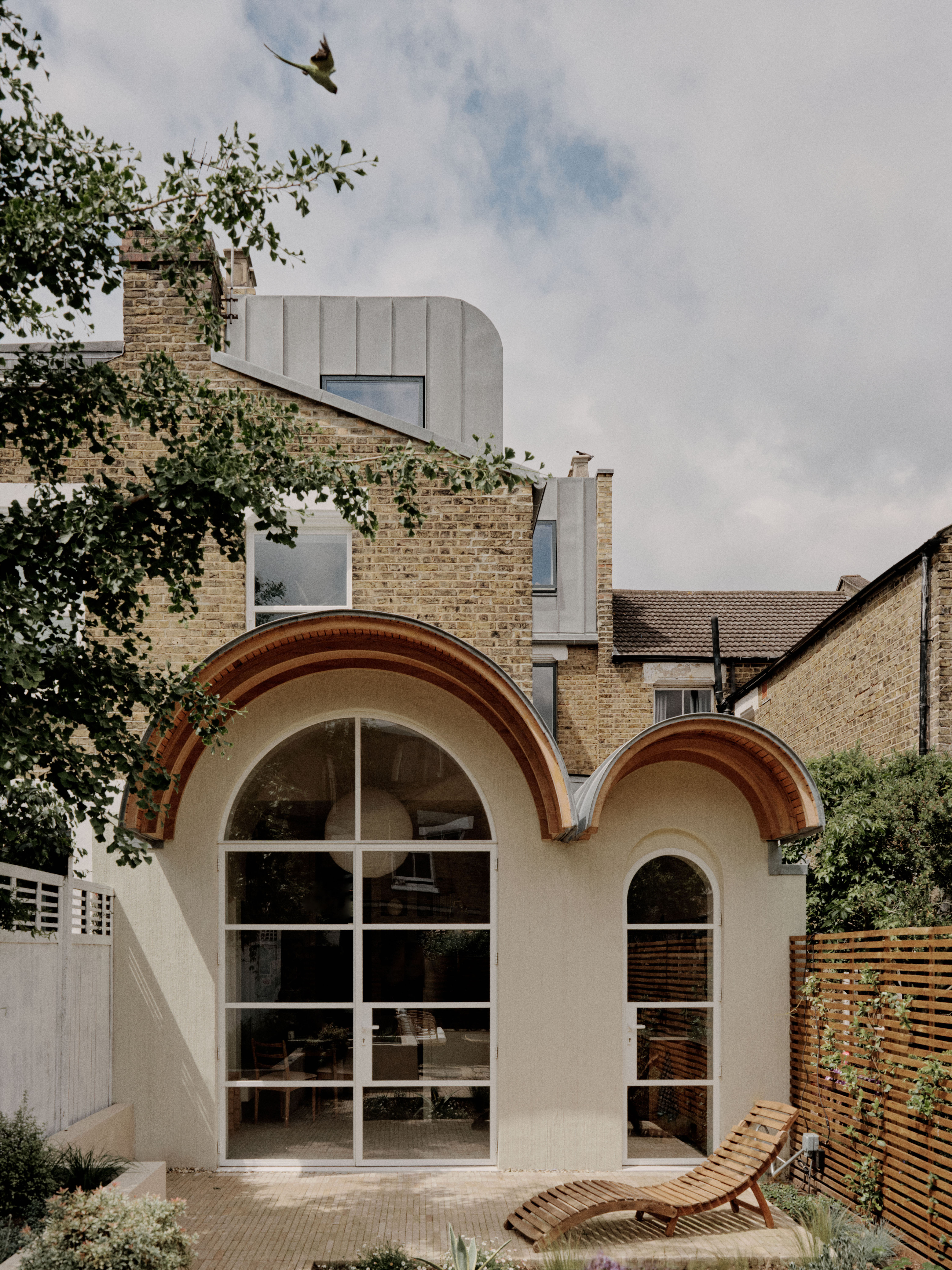
Image Credit: Richard Oxford
JB: Would you say it’s true that part of your USP comes from your ability to handle potentially problematic concerns, such as listed buildings, planning applications and properties in conservation areas?
AD: Yes, I’ve always enjoyed working on tricky projects where a problem provokes an innovative response. Sometimes, a degree of constraint enables innovation, and if you arrive at an elegant solution whilst doing so, it is always a treat for the clients to spot that too and trust in the design.
At Nunhead Cemetery house it was a little easier on two fronts to propose an ambitious design. Firstly, although the terraced house fronted onto the Conservation Area, it was actually on it. Secondly, the clients were repeat clients. We’d already worked closely before on their first house nearby. On this site, the rear garden sloped away from the house and across the house in the area of the side return, where they wanted both a ground rear side extension and a courtyard. This made it challenging to create a consistent and generous volume to the rear and side extension when considering the boundary height. By positioning the lowest point of the arch on the boundary at a height acceptable to the planners, the internal volume wanted was achieved without harming the neighbour’s daylight. This same curved corner detail is echoed in the second-floor outrigger roof extension, which allowed more light into the courtyard.

Image Credit: Richard Oxford
JB: Those arches really soften the building too, but I can’t even begin to figure out how you got to those beautiful - and functional - proportions!
AD: The arch of the side return was arrived at first, from outrigger flank wall to boundary, and then this diameter was multiplied by the golden ratio to form the arch diameter of the adjacent rear extension, giving proportion and rhythm to the new rear. To shield the glazed doors from the south sun and provide an awning to the rear garden, there were key engineering and roofing challenges. The result was two cantilevered arched awnings that do not touch - making them appear lightweight and elegant.
JB: I’m always intrigued to discover how involved architects are during the construction stages of a project. What is your role during this post-design phase of a project?
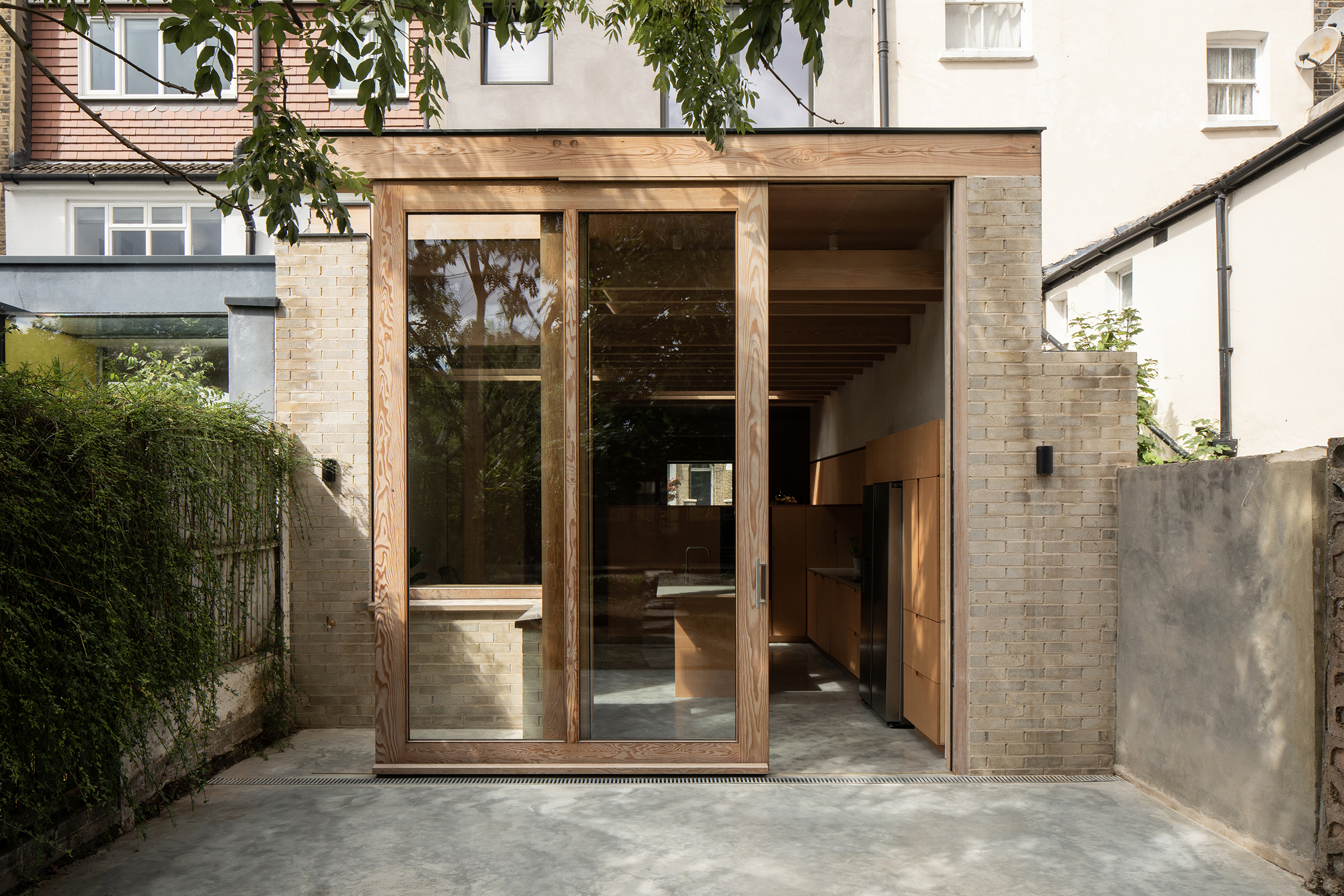
AD: Peckham House always had a trusting and ambitious client who understood that getting the best value from an architectural service was for Draper Studio to have oversight of the three core stages: 1. Planning, 2. Technical Design and 3. Construction. On site we’d already anticipated extensive digging of the shared underground drainage, which became the reason for the split-level kitchen and diner. The client was delighted about the 3.4m high ceiling that this created, but retained us to work through options for the 3.6m high sliding rear door even whilst on site. We originally specified and tendered aluminium frame versions as a package, but due to fluctuating costs and finally the frame being deemed too large for them to warranty, we pivoted towards kiln-dried Douglas fir from the timber frame supplier. On this project, architectural fees were time-charged throughout, and this gave the client the flexibility to draw down on their budget as architectural input was required, even throughout the construction phase, where overall it averaged out to fortnightly site visits over a 12-month build.
JB: There is a sensitive approach to materiality in all of your projects, with a particular emphasis on naturally sourced surfaces. Can you tell me a little more about how you create and source your material palettes?
AD: There’s a rational and mannered feel to certain projects, and with other projects, an opportunity for more play. Sometimes there’s a blend, and in both Wandsworth and Hackney house there's both reason and story.
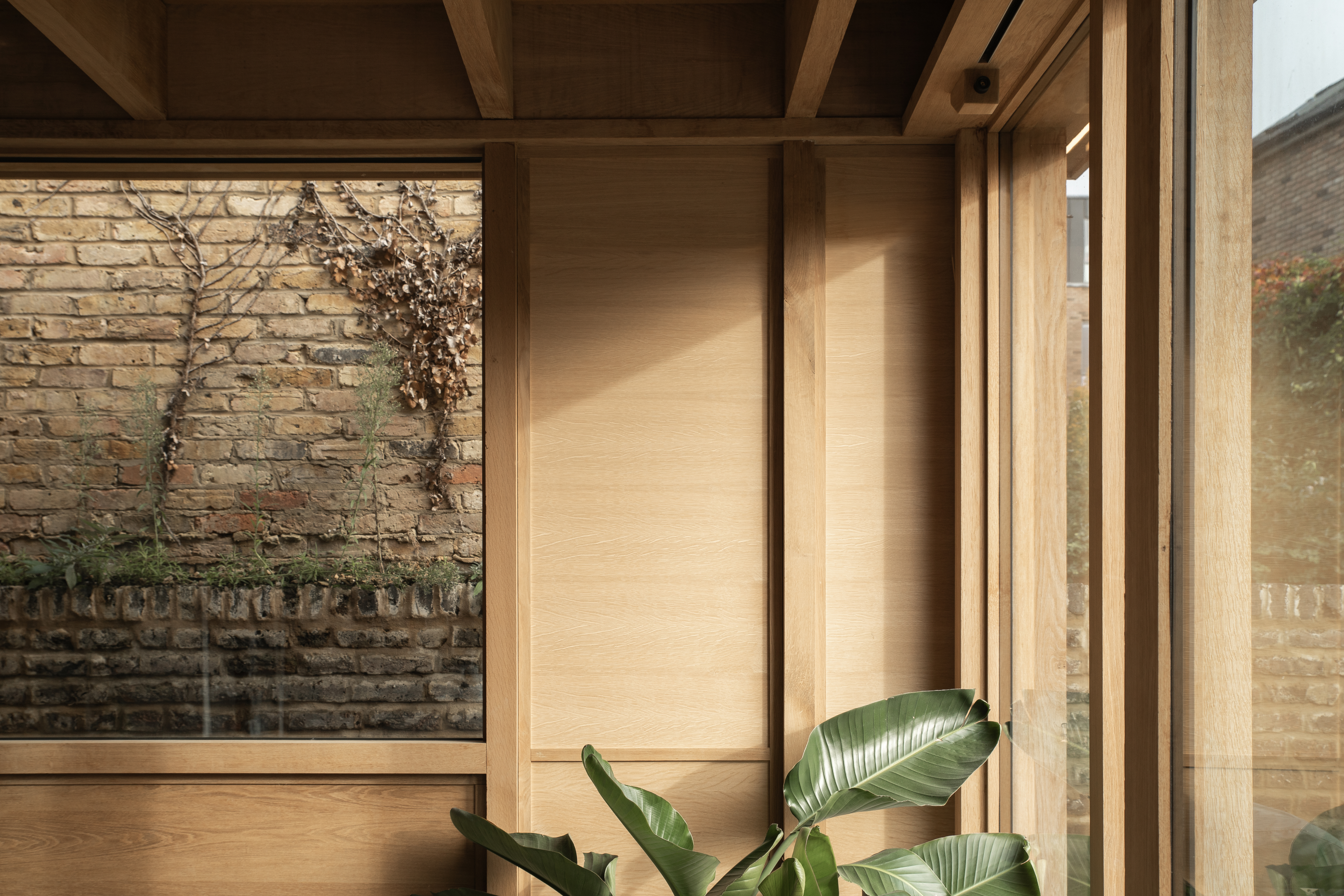
Wandsworth House has a number of practical challenges: clear span 12m x 6m of rear extension flat roof without it looking top-heavy. The roof structure is to appear lightweight and strong enough to support a 1st floor family bathroom pod and allow the sliding doors to sail behind the supporting timber posts that correlate in a grid aligned with the main house openings. The glazing is not flat, but incrementally steps inwards towards the door openings, providing a sheltered space when the door is opened, and harnesses the filigree of timber posts to screen direct daylight and reflect back the passing train noise. There was little other option than to use joinery grade, kiln-dried French oak. A matching rift cut, oak-veneered ply deck performed both the structural warm deck and the internal ceiling finish.
The overall structure was so efficient and lightweight that it meant the whole extension's foundations could sit atop 28 steel piles, saving an estimated 70% of volumetric concrete that otherwise would have been needed to structurally span this extension’s roof in steel.
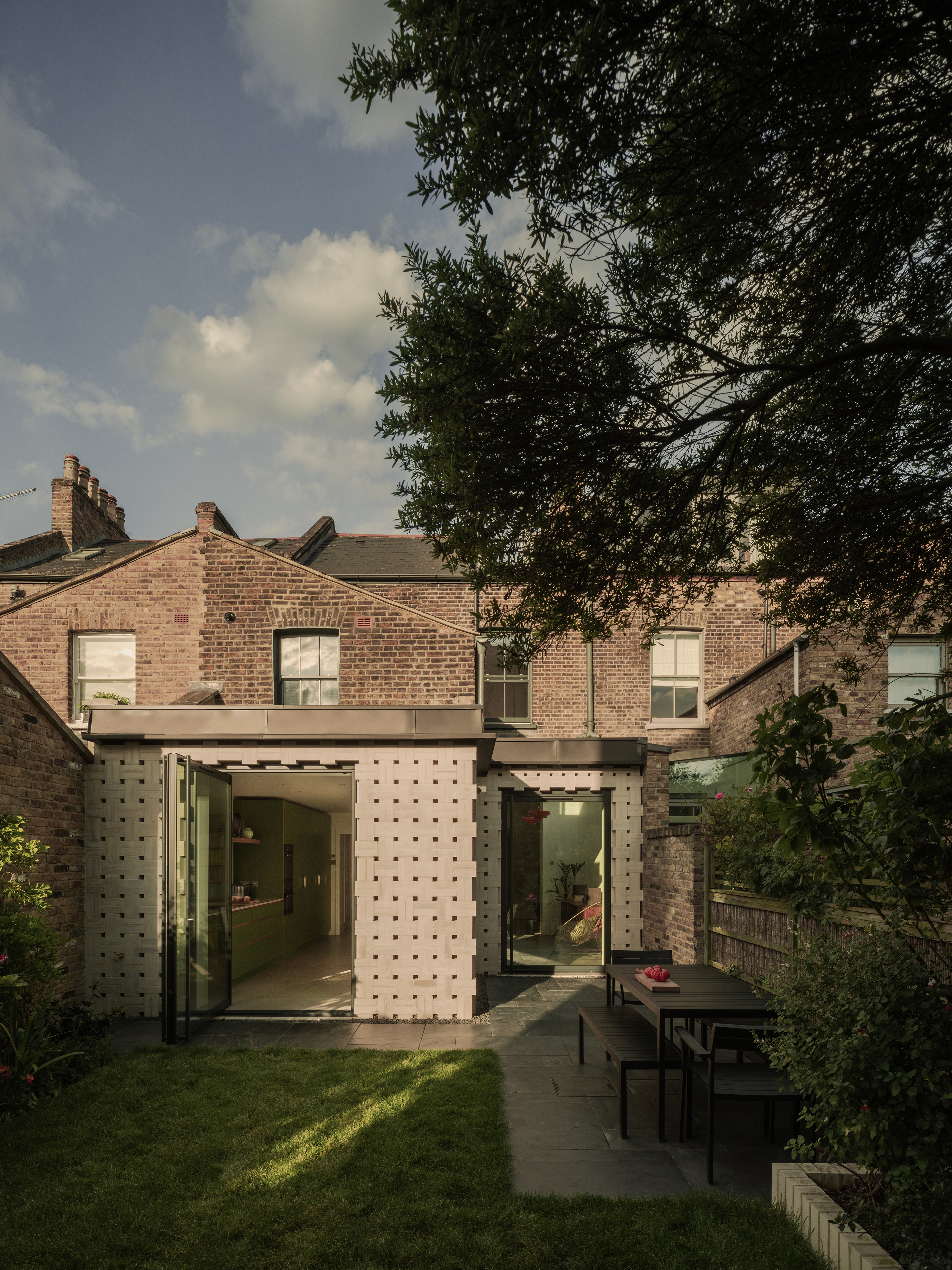
Image Credit: Peter Molloy
JB: I couldn’t help but notice the stone bricks used on the Hackney project - and they’ve not been laid in the conventional manner.
AD: At Hackney the client wanted an extension that was just as much about extending the garden as it was about extending the house. The brick basketweave pattern was arrived at following a desire for a more playful treatment of the facade, akin to how garden boundary walls are treated - with perforations and single skin patterns. The Client also wanted the new space of a kitchen and dining room to make the communal parts of the house better cohere but also didn’t just want a brick box.
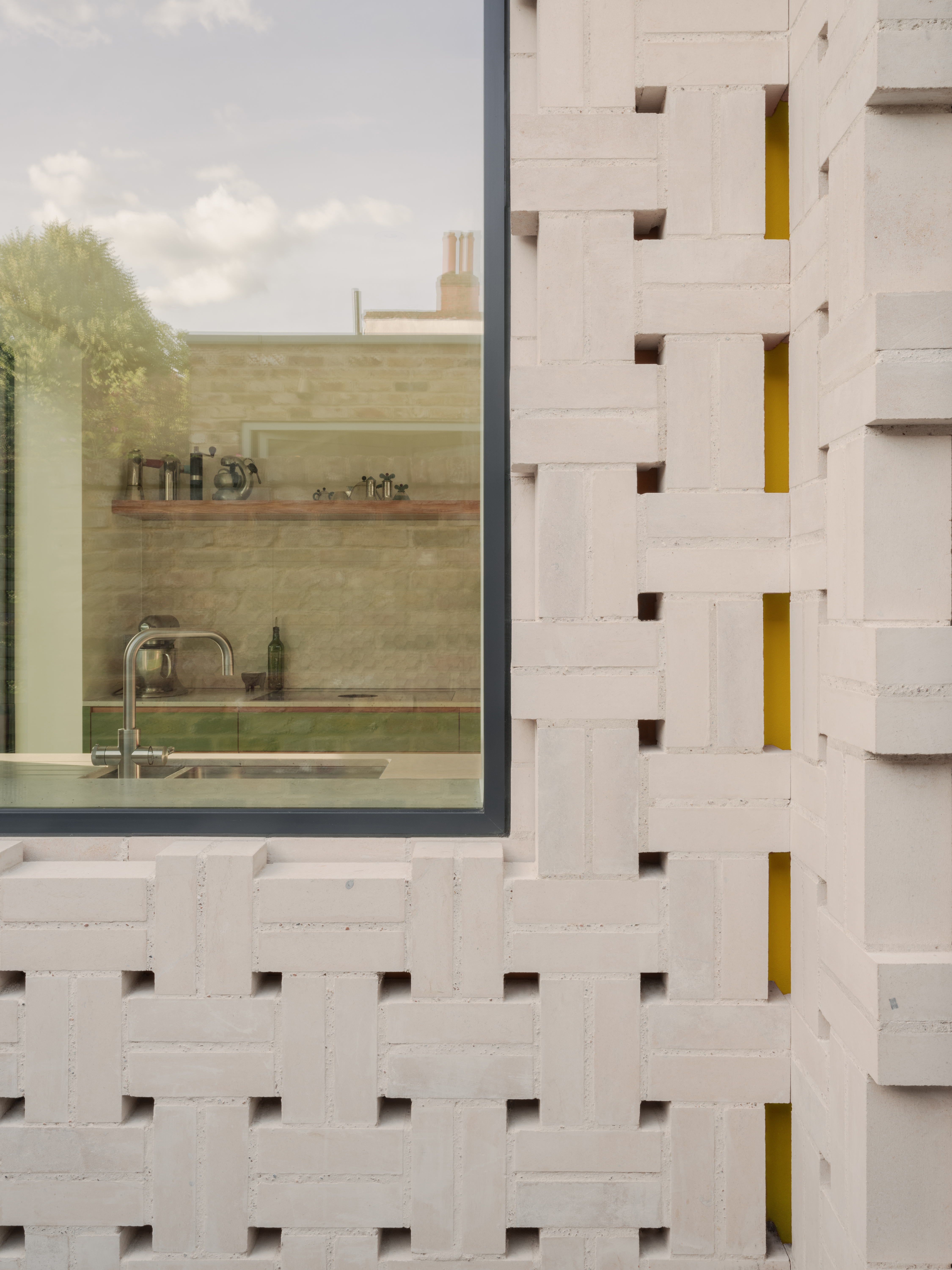
Image Credit: Peter Molloy
Underneath the “rain skin” of brick is a searing yellow render that is picked out by the sun when it tracks onto its south westerly aspect. Its a nod to how a smart jacket can have the discreet flair of a flashy lining. The creation of the basket weave pattern in a single skin requires a degree of precision and tolerance. Add into the mix the mortar is NHL3.5 Lime, we also needed patience as the wall rose up 4 courses per day! It did so however, in this clean and precise manner because the bricks are precision cut. Some of the saw marks and inclusions to the otherwise light yellow limestone are left on show as a further highlight of the maker’s marks - be that the stone cutters or geology.