

News: WFF Unveils Industry-First Quality Mark for Safer Worktop Fabrication


The Worktop Fabrication Federation (WFF) has launched what it describes as a first-of-its-kind quality mark aimed at helping specifiers, retailers, designers and consumers identify kitchen worktops that have been fabricated without putting workers’ health at risk.
As we’ve reported, the scheme comes against a backdrop of growing concern over silicosis linked to poor control of respirable crystalline silica (RCS) in fabrication workshops. By introducing an independently assessed mark, WFF says it wants to clearly differentiate responsible businesses from those “willing to risk having a beautiful kitchen at the cost of someone’s health or life”.
At the heart of the quality mark are regular, independent workplace assessments carried out by professionally registered occupational hygienists. These assessments focus on the recognition, evaluation and control of health hazards, particularly those associated with high-silica materials. Kevin Bampton, chief executive of the British Occupational Hygiene Society (BOHS), said the intention is to give the supply chain “a clear choice”. “Buying a worktop from an accredited company means you are buying from a business able and willing to protect a worker’s health,” he said. “Buying elsewhere means you are willing to risk having a beautiful kitchen at the cost of someone’s health or life.”
Accredited fabricators will also actively promote the Lungs at Work project, providing a direct referral route for workers who may previously have been over-exposed to silica to access medical screening. In line with emerging clinical recommendations, participating businesses must commit to enhanced health surveillance to support earlier detection of respiratory risk.
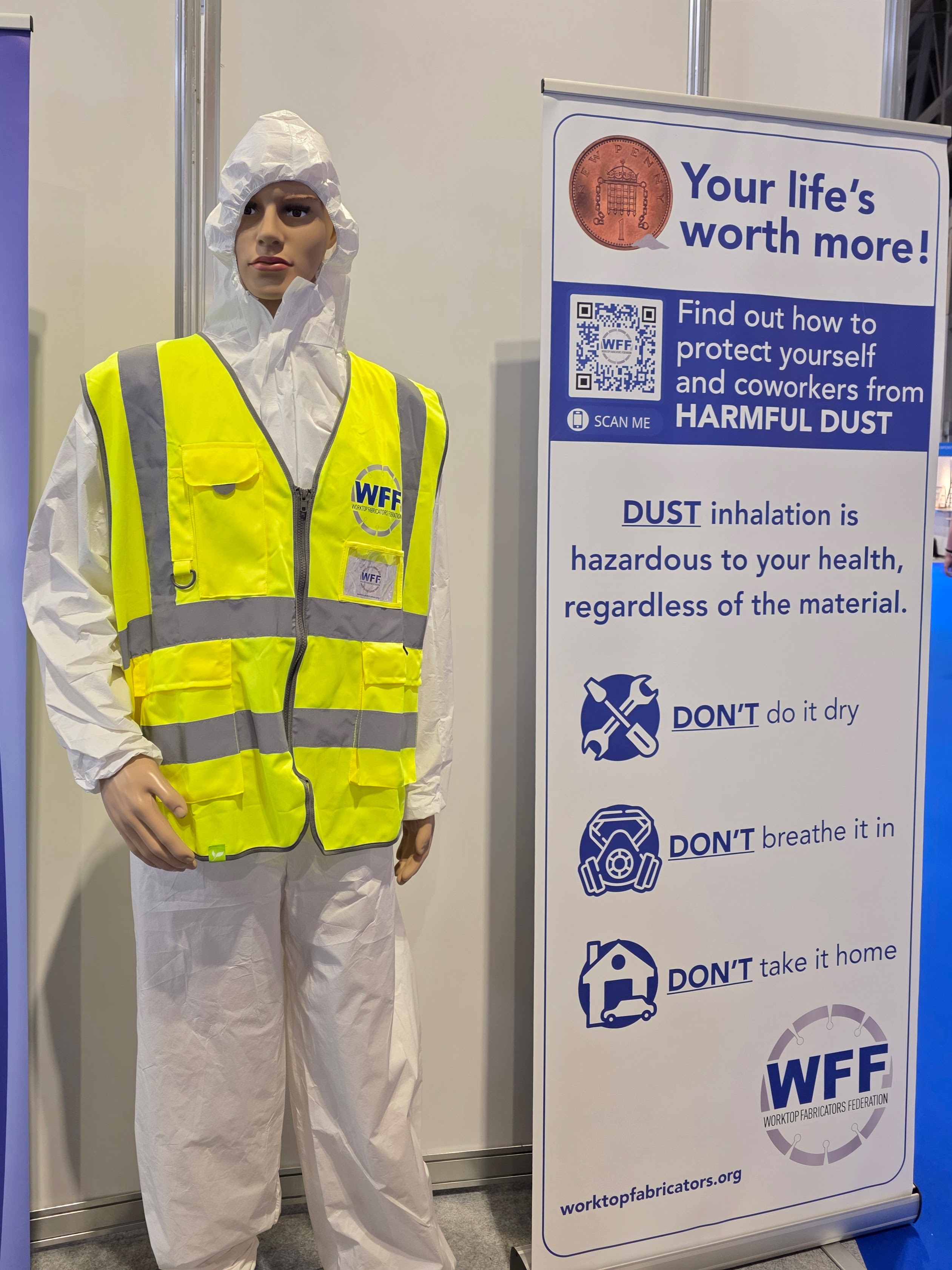
While engineered stone is a key focus, the WFF stresses that the quality mark applies to all high-silica materials that can pose a health hazard if not properly controlled. The scheme allows retailers and the wider construction supply chain to verify whether products have been fabricated in environments that comply with recognised good control practice. Accreditation status will be publicly displayed and easily checked via the WFF website.
Fabricators seeking the mark must demonstrate robust management systems, effective exposure controls, comprehensive training, and safe storage and handling of materials. The criteria align with guidance from the Health and Safety Executive (HSE) and BOHS, with BOHS specialists continuing to review and strengthen the requirements.
BOHS has worked alongside WFF to develop training and research that tackles real-world barriers to effective control. Dr Johanna Feary FRCP, PhD, highlighted why this approach matters. “Silicosis is a preventable but irreversible lung disease, and we are seeing increasing numbers of cases linked to poorly controlled exposure,” she said. “An initiative such as this kitemark… is a significant step forward in protecting workers’ respiratory health.”
She added that focusing on education, effective exposure control, avoidance of high-silica products where possible and early health surveillance “has the potential not only to reduce future disease, but to identify people at risk earlier, when interventions can still make a meaningful difference”.
Dr Scott McGibbon, director at Pvotal Consultancy, described the requirement for independent occupational hygiene assessments as a landmark for British manufacturing: “The WFF partnership with BOHS, underpinned by the new quality mark, signals a strong commitment to raising occupational hygiene standards and providing trusted, independently verified assurance of workplace health practices.”
The quality mark signifies a positive start to 2026 for the industry, with WFF positioning it as a practical tool to improve confidence, compliance and, ultimately, worker health across the worktop fabrication sector.