From the organisers of The Stone & Surfaces Show

  • Log in
  • Home
  • News
  • Jobs
  • Call for Submissions
  • Events
  • Advertise
  • Home
  • News
  • Jobs
  • Call for Submissions
  • Events
  • Advertise
Main Image
20251013_081212.jpg

News: Reinstating Value to Worktop Waste

2025-11-25


In a sector increasingly attuned to circular economy thinking, the Worktop Fabricators Federation (WFF) has announced a partnership with Reutilize, a platform designed to help fabricators turn underused stock into opportunity. For workshops where offcuts and full slabs often linger on racks “just in case”, the collaboration offers a simple, scalable route to material efficiency.


Reutilize provides a searchable, industry-wide database of surplus stone, quartz and porcelain. Instead of occupying valuable workshop space or, worse, making their way to landfill, offcuts can be listed for others to find and use. The idea is simple:  to make existing material visible. After all, in an industry rich with high-value resources, waste is often a problem of information rather than intention.


Tim Matthews developed Reutilize out of the day-to-day reality of managing Counter Production, a large fabrication business. He found that even the most efficient purchasing strategies can’t eradicate leftover material as “waste,” which the original buyer simply doesn’t need. Watching such surplus stock accumulate, he started asking a question central to today’s circular-economy mindset: “If we don’t need it, who might?”


The platform was built to answer that question at scale. Reutilize, he explains, is “a large, searchable, connected database of every registered company’s stock list, all in one place”, allowing fabricators to put leftover material in front of buyers who might already be searching for it. The logic is simple: “It makes no sense in a world of rising costs and resource depletion to make something new, when it’s likely it already exists… What one person sees as ‘waste’ is often another’s ‘need’.”
 

He adds that the WFF partnership was part of a natural evolution:  “I agreed early on that we would allow WFF members to use Reutilize for its members’ purposes, as they represented the right kind of companies we wanted to push for this initiative. Using up existing stock is important, but doing it through companies who are applying the correct levels of H&S is also important, even though Reutilize isn’t there to police this process.”


For WFF members, the partnership means an immediate opportunity to cut landfill, free up space and generate value from stock that would otherwise sit idle. Nigel Fletcher, Operations Officer for the WFF, comments:  “We’re delighted to be able to offer our members this service helping them to clear remnants, stop filling up landfill with offcuts, while adding to their bottom line profit. It’s a win-win and a great partnership for us.”


That said, Nigel has still observed varying perspectives among WFF members regarding remnant stock, noting that while business owners recognise its value, it may not always be the priority at the middle management level. To counter this, the team have incorporated a complementary inventory system into the platform, which will soon have its own independent website. As Nigel explains, “Reutilise data is managed in an Excel spreadsheet, allowing users to easily list stock items as visible or private, providing complete control over yard inventory. While basic, it can offer significant benefits, particularly for those who have not previously implemented such a solution.”


The platform’s wider ambition aligns neatly with the ‘reduce, reuse, reutilize’ banner, underlining actions seen across construction and architecture, where material reuse is no longer a fringe initiative but an essential strategy for reducing environmental impact while safeguarding profitability.  In collaborating with the WFF, Reutilize builds on success in the solid-surface sector, broadening access to a system that treats unused stock not as a burden but as a resource. 


limittext
Off
Exclude From Lists
Include
Company Tags
M10
CAPTCHA
SEO Title
WFF and Reutilize partner to unlock the value of waste
Read more
Main Image
1_s1310577_lundhs_hq_larvik.jpg

Surface Perspectives: Ben Ayling, Lundhs

2025-11-24


Ben Ayling is the UK business development manager for Lundhs, Norway’s leading supplier of Larvikite and Anorthosite, and member of The Stone Collective. Let’s scratch below the surface to find out what makes Ben tick…


What does a typical day look like for you?


My days revolve around helping architects, designers, and fabricators understand how natural stone can solve practical and aesthetic challenges. I spend much of my time visiting studios and sites, delivering RIBA-accredited CPDs, and reviewing upcoming projects where Larvikite may be the right solution. Communication is a major part of the role. I translate technical information from our quarries in Norway into clear, practical guidance for UK project teams. No two days are the same, but most involve conversations about design intent, performance, and how to use stone well.


How integral are materials to your day-to-day? 


Materials are central to everything I do. I work with Larvikite daily and spend a lot of time comparing it with other surfaces used in the UK. I think about materials constantly, whether that’s appearance, surface performance, or long term durability. Most of my work involves explaining these qualities to architects or fabricators, often through samples, site discussions, or technical reviews. Stone is tactile, so I focus on helping people see and understand it firsthand. Communication about materials is a core part of my role, and it shapes almost every conversation I have.


What are the biggest lessons you have taken forward from your original training? How has your education informed your career?


My background is in business, communication, and fabrication rather than geology, and that has shaped how I approach the stone industry. The key lesson from my early training was the value of clarity. Good decisions rely on people understanding a material, its performance, and its purpose. That mindset has been essential in a sector where natural stone can seem complex. My education taught me to look at the bigger picture, ask the right questions, and communicate simply and honestly. Those skills have proved more important than any technical training.


Which project/s are you most proud of being involved with and why?


317 Finchley Road stands out. It is a rare example of load-bearing stone used for residential blocks in the UK. The project required collaboration, problem-solving, and a determination to see Groupwork’s original vision implemented as intended. It was a significant undertaking for our team in Norway to adjust to the challenges presented, yet they did so with real skill and commitment. The project has since become a case study for The Stone Collective, showing the industry what is possible when stone is treated as a structural material rather than just a surface. I am proud of its ambition and its outcome.


What do you feel are the main challenges facing the stone and surfaces industry today?


Education remains the biggest challenge. Many decision makers do not fully understand stone performance, quarrying, or long-term value, while competing materials often market themselves more aggressively. Misconceptions around sustainability are also common, with natural stone sometimes compared unfairly to high-carbon products presented as “eco-friendly.” Consistency of supply, skills shortages, and increased pressure on logistics all play a role, but the underlying issue is knowledge. The industry needs clearer communication, better data, and more transparency to help designers and clients make informed decisions.


In your opinion, what are the positives of using stone in the built environment? 


Stone is durable, low maintenance, and inherently low carbon because Mother Nature put the energy into creating it for us millions of years ago. It requires minimal processing compared with manufactured materials and develops character rather than degrading. Stone performs well both structurally and aesthetically, whether used for worktops, cladding, paving, or load-bearing elements. Its natural variation gives buildings depth and authenticity, while its strength makes it a reliable long-term choice. Stone also contributes to simplicity in design. It doesn’t need coating or imitation. It stands on its own merits, offering an honesty that is increasingly valuable in today’s built environment.


How does sustainability shape your thinking and decision-making, and how do materials fit into this?


Sustainability is central to my work. I encourage designers and engineers to consider whole life value rather than upfront cost, because natural stone often delivers the lowest embodied carbon when sourced responsibly. Larvikite, for example, requires minimal processing and offers long-term durability. The Stone Collective was created to support this shift in thinking and promote stone as a genuinely sustainable option. For me, sustainability is not a badge but a set of decisions around source, transport, lifespan, and performance. When viewed through that lens, natural stone becomes an obvious and responsible material choice.


limittext
Off
Exclude From Lists
Include
Company Tags
M10
CAPTCHA
SEO Title
What makes a supplier of Norwegian Stone Tick?
Read more
Main Image
img_9755.jpeg

A Day in the Life: Vicky Sharrocks, Hardscape

2025-11-21


Hardscape is a leading UK supplier of high-quality hard landscaping materials for public realm, commercial, and urban regeneration projects. As one of their valued Sales Managers, Vicky Sharrocks oversees client relationships, supports designers and contractors, and helps deliver tailored material solutions that bring ambitious landscape schemes to life. But what does her daily life tend to look like?


My day starts…

Like most people, my mornings are pretty busy. It’s all about getting everyone out of the house on time and making sure we’ve all had something to eat before the day begins! Once that chaos settles, it’s a quick coffee, a scan through my emails, and then I’m ready to go.


I’m usually found…

All over the place! Some days I’m based at our Bolton factory, catching up with the team or checking through materials in the warehouse. Other days I’m out visiting merchants, contractors, or clients. My role covers both Hardscape Surfaces and Hardscape Warehouse, so there’s a real mix of office time, site visits, and customer meetings. That variety is what I enjoy most — no two days are ever the same.


My typical day involves…

A bit of everything, really. I could be organising stock, helping customers find the right product, or putting together displays and samples. I also spend time following up with merchants to make sure they’ve got what they need and supporting with any training. It’s a busy role but very people-focused, which suits me perfectly.


The thing that surprises me most about my job…

How much goes on behind the scenes before any stone even reaches a project. From selecting the right material to managing logistics and ensuring quality — there’s a lot of coordination involved. People often see the finished product and don’t realise the amount of teamwork that happens to get it there.


When I was younger I wanted to be…

Something creative, though I’m not sure I knew exactly what! I always liked the idea of working with people and doing something hands-on — so I think I’ve found the right balance here.


Something you might not know about me…

I’m a big football fan. Most weekends involve some sort of match — whether it’s watching a game or standing on the sidelines cheering family on. It’s a big part of our family life and a great way to switch off from work.


My most memorable moment at work…

There have been a few! The standout ones for me are the schemes I’ve watched come to life — seeing a project progress from drawings and discussions to a completed space is always special. The day I got my promotion into my current role was another big highlight; it felt like a real milestone and a reflection of how far I’d come. And I can’t forget the summer socials the group organises as part of our AGM — they’re always great fun and a nice reminder that while we all work hard, there’s a really strong team spirit across the company. Hardscape has a great work ethic, and it’s genuinely a brilliant place to be.


If I could give one piece of advice to someone considering a career in the stone industry…

Get involved and don’t be afraid to ask questions. The stone industry is full of knowledgeable, passionate people who are always willing to share what they know. It’s an industry that rewards hard work and genuine interest — and there’s always something new to learn.


limittext
Off
Exclude From Lists
Include
Company Tags
M10
CAPTCHA
SEO Title
Getting to know Vicky Sharrocks of Hardscape
Read more
Main Image
upland_road-fkoch-8.jpg

News: Championing the Use of Structural Stone

2025-11-21


As we reported earlier in the week, The Stone Collective has returned with the next installment of its 6-part book series. Where Volume 1 laid the groundwork by outlining the principles, possibilities, and environmental arguments for structural stone, Volume 2 continues to push back the barriers to specification, offering architects, engineers, developers, quantity surveyors, and educators an invaluable new item to their toolkit. 


Comprising of industry leaders, Johnston Quarry Group, Hutton Stone, Lundhs, Paye Stonework & Restoration and The Stonemasonry Company, the team launched the book in London at The Market Building. Pierre Bibaud of The Stonemasonry Company gave an illuminating presentation, mirroring the insight and passion contained within the book.


The essays cover themes including stereotomy, digital archaeology and discussions around modernising the use of stone, along with a series of case studies written by a panoply of industry professionals. 


In celebration of the launch and the team’s hard work and endeavour for the industry, we thought we’d share a timely essay from the book that gets to the heart of the structural stone reawakening, from an engineer’s perspective. 


Engineering with Stone

Alex Lynes, Associate Director of Webb Yates 


Stone is most commonly seen as walls in historic buildings, thin cladding on new ones or internal finishes but how we use stone could hold the key to unlocking the low carbon construction of the future. 


For many years we have been complacent with our structural materials, relying on homogeneous steel and concrete alone for all structural applications. This has become the case even where it makes little sense, large steel beams or concrete slabs are common even in low rise buildings where they are not needed. To tackle the climate emergency we need to diversify our material use and especially look to use traditional materials in a modern way.


Image Credits: Webb Yates

Image Credits: Webb Yates


The main ingredient of concrete is stone; if local concrete is available then local stone is available. Stone is stronger and more durable than concrete, it exhibits negligible creep so less deflection, its higher density provides better acoustic and vibration characteristics as well as thermal mass. In all ways its properties are better than concrete, yet it is overlooked as a structural material.


The main constraint on stone is that it comes in solid blocks of limited size. Using modern cable tensioning methods to link smaller blocks into larger prefabricated elements can overcome this. Structural stone is now being used to make beams, columns, floor slabs, trusses and foundations. Stone is useful not just in isolation, it can be combined with engineered timber products such as glulam and CLT to create low carbon structures fully based on natural materials. 


Image Credits: Webb Yates

Image Credits: Webb Yates


The higher mechanical properties of stone enable smaller section sizes compared to concrete but we also need to be using materials efficiently, especially as stone can be more expensive per cubic meter. Trying to simply swap out a concrete flat slab for stone could result in a missed opportunity. To truly design sustainably we need to understand the material, its strengths and weaknesses, how it is shaped and assembled, where it comes from. For example, stone can be used as thin slabs compositely on top of glulam beams to utilise the benefits of both timber and stone, producing an elegant exposed soffit that provides acoustic separation, thermal mass and is easy to assemble on site. New structural stone forms show what is possible when natural materials are used effectively.


Project Details: 


Niwa House features an entirely timber and stone superstructure. Within the roof, thin stone slabs work in compression, glulam beams in tension, and together they form a system around 150% stiffer than timber alone. The stone provides thermal mass that keeps the interiors comfortable. It is structure, architecture and environmental system rolled into one and is the first use of the system at full scale.


Architecture by

Takero Shimazaki Architects


Engineering by

Webb Yates


limittext
Off
Exclude From Lists
Include
Company Tags
M10
CAPTCHA
SEO Title
Stone Collective Launches Volume 2 and Spotlights Structural Stone
Read more
Main Image
img_8004.jpg

Case Study: WIP at Finchley Road

2025-11-20


The redevelopment at Finchley Road continues to evolve as one of the UK’s most ambitious demonstrations of load-bearing stone construction. Although still a work in progress, the project has already become a reference point for architects and engineers exploring alternatives to carbon-heavy steel and concrete. The scheme, designed by Groupwork and led by architect Amin Taha with structural engineering from Webb Yates, has followed a winding procurement journey with plenty of changes along the way. Yet its central idea has remained: a tall, fully structural stone exoskeleton built to modern fire standards, offering long-term carbon savings through minimal processing and an (almost) self-finished envelope.

Image Credit: Webb Yates


The stone frame has been designed as a sway frame, with fixed connections between beams and columns. Webb Yates built a full-scale connection mock-up to test the connection strength, which was tested under 1.5 times the design loads. Eleonora Regni of Webb Yates explains the basic principles:


 “To minimise tension and bending moments in the beam elements, the frame was designed so that all vertical loads are carried by the columns, allowing the beams to act primarily in tension to provide lateral stability.”


At its highest point, the building is set to be 10 storeys high, which called for a dense igneous stone for the exoskeleton structure, with Italian Basalt originally chosen for its compressive strength and compliance with new fire regulations. Yet, as practical as such stone may be, it has its limitations, which, along with the site’s many restrictions, have led the team to some creative problem-solving.


Located close to Finchley and Frognal station, the space is somewhat tight, and as Eleonora underlines, “Due to Network Rail safety procedures, the crane was subject to strict lifting limits, so the stone elements were designed to fall within those limits.” What’s more, being a natural material does have its drawbacks, not least in terms of the sizes available. In requiring very long lengths of stone, the team were faced with a challenge. Drawing on their collective experience of producing Clerkenwell Close, the team has once again used a splicing method, which Amin describes as “stitching stones together to allow longer column and beam spans, opening the structural grid.” As Elenora adds, this also allows “heavier elements to be divided into smaller sections that can be assembled on site.”


Of course, all builds involve a network of companies, specialists and suppliers, and with Finchley Road, there have been moments of unpredictability, as Amin illustrates, “The project has been bought and sold three times, which also meant a change of main and subcontractors.” Having originally begun the build with AteliersRomeo’s Sicilian basalt, the most recent evolution has seen the introduction of Lundhs’ Norwegian larvikite. As Eleonora points out, the material “offers a compressive strength of around 170 MPa, compared with approximately 35–40 MPa for standard concrete.” Amin also notes that the general use of stone produces “ 98% lower CO2/m3 than reinforced concrete or fired clay brick and 99.6% lower than mild steel.”


The larvikite was manufactured within Lundhs quarry facilities near the southern coast of Norway, and from there, they were shipped to Tilbury and Immingham docks for onward transport to site. Lundhs’ business development manager, Ben Ayling, knows all to well how complicated it has been to get the material onto site, and stresses that cross-party collaboration was key:


“As storage space on site was very limited, deliveries had to be carefully sequenced and timed to support continuous installation. Loading operations also relied on the temporary use of an adjacent bus lane, which made precision and coordination essential. Through close communication between the construction company, Ernest Park, and our project manager, we maintained an accurate delivery rhythm that minimised storage risks and supported a smooth, uninterrupted build programme.”


The programme has steadily begun to run more smoothly, with a notable structure rising up, and already grabbing the attention in a busily built-up area. Internally, the larvikite has shown its versatility, with single pieces used to form the floor-to-floor lift core, while standard brick laying techniques have been used to produce the service riser from larvikite blocks. Amin states another benefit here, “Being self-finished stone and needing neither fireproofing layers nor extra finishing layers saves a considerable amount of costs and carbon.” 


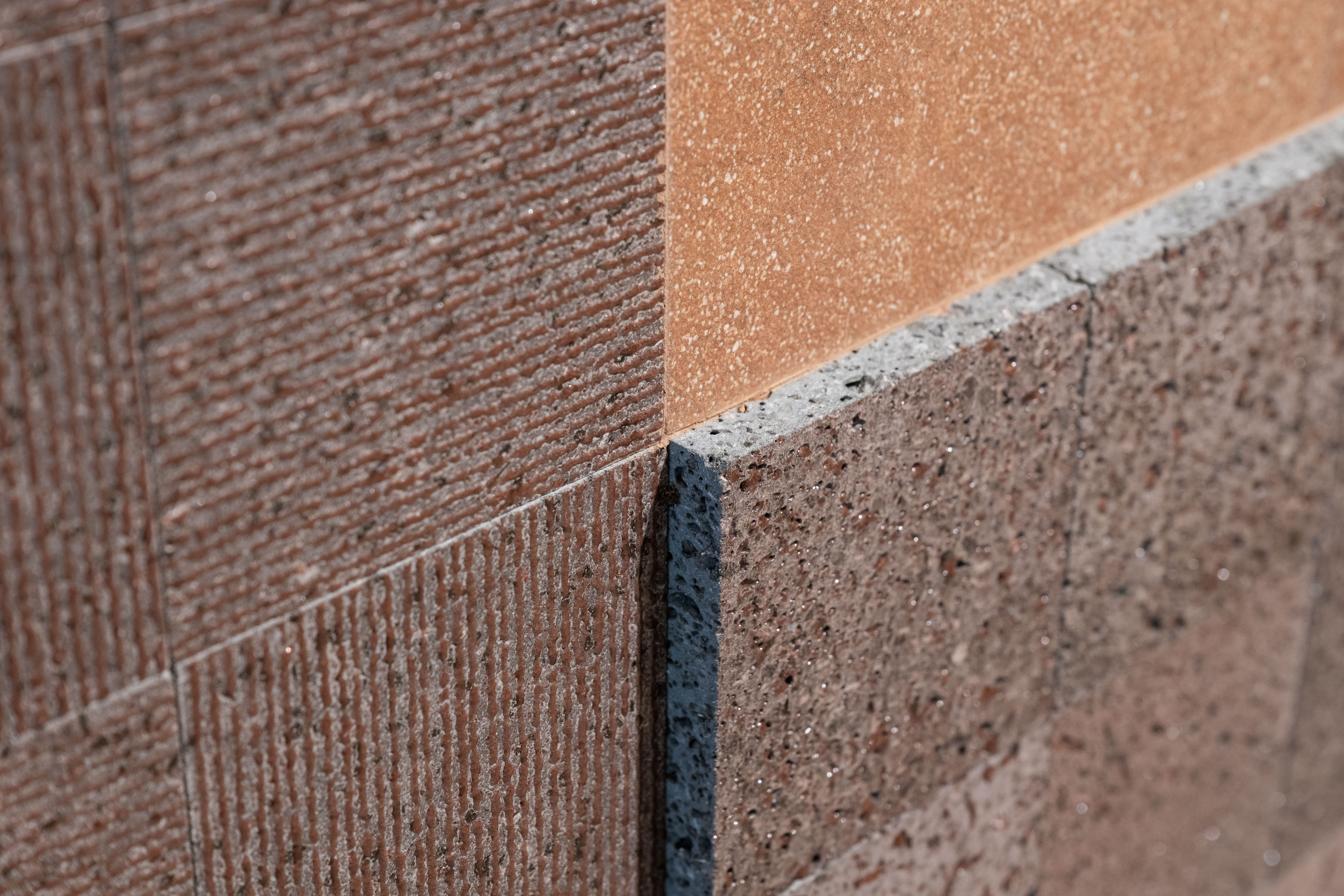
Although the eagle-eyed amongst you may note that the exterior aesthetic of this emerging structure has been altered from its original state. Indeed, the dark tone of the larvikite has been veiled by a coating of dusty red paint. Ben explains that, “The requirement to paint the stone came from local planning rules intended to reflect the area’s Victorian red brick character.” In many ways, this could be viewed as a compromise on the material, but Ben adds, “it’s a small price to pay to realise a load-bearing stone project of this scale.” For Amin, overcoming the initial discomfort of this procedure may also have led to a happy accident: 


“At first we were reluctant to the idea, but when told by a British quarry that this method had been used for generations to match stones fresh out of the quarry to those standing for hundreds of years, we realised it was a new line to investigate for this and the next projects.”


It has also allowed the team to create moments of contrast within the building's overall design, with those self-finished internal elements remaining in their natural state - and soon to be unveiled, as this bastion of structural stone draws close to completion.


limittext
Off
Exclude From Lists
Include
Company Tags
M10
CAPTCHA
SEO Title
Sneak peak of a bastion of structural stone
Read more
Main Image
studio_folk_edward_powe.jpg

Interview: Edward Powe, Studio Folk Architects

2025-11-19


Fresh from collecting the RIBAJ Rising Star Award 2025, we were lucky enough to catch up with Edward Powe, founder of Studio Folk Architects. 


The accolade represents a worthy milestone for a young practitioner already blazing a trail in the built environment. Following an undergraduate degree in Architecture at the University of Kent, Edward completed his Master's in Architecture at the Royal College of Art, before achieving the often elusive Postgraduate Part 3 course at Cambridge. After a period as an associate at DK-CM, where he worked on a range of historic refurbishment, and strategic placemaking projects in the public sector, he set off on his own and founded the studio in 2023. This year, Patrick O’Keeffe joined the practice, which, as Edward explains, champions the use of natural materials and collaboration in construction.


Image Credit: James Retief

Image Credit: James Retief


JB: Firstly, congratulations on your recent RIBA Rising Stars Award. How does it feel to be recognised fairly early on in your career, and what does it mean for your practice, given that it is still only a few years in?


EP: I’m of course delighted to have been chosen by the RIBAJ to be part of this year’s cohort, alongside some incredibly talented young practitioners. It’s recognition of a wider trend towards more collaborative working practices in the construction industry. My hope is that the award will help our practice bring some of the craft-led approach we’ve been testing to larger projects and collaborations.


JB: I’m always heartened and intrigued when practices openly discuss the importance of collaboration to their work, and it strikes me that you do so actively in both the human and digital senses.


EP: We call ourselves a craft-led practice. We believe in the value of bringing in people who are experts in their specific craft wherever we can, with enduring, characterful and sustainable buildings being the result. What has surprised us is that crafts traditionally seen as “old-fashioned” are now often utilising advanced digital technologies. For example, the stone sculptors and ceramicists we work with frequently model and test their ideas in the digital space before working them by hand. This allows us to seamlessly integrate these elements into our built schemes, and it’s something we’re excited about exploring further.


We are also working on a recent competition-winning scheme to deliver public realm in London, for which we are developing innovative ways of engaging beyond the design team—working more closely with our clients and local communities.


Image Credit: Studio Folk Architects

Image Credit: Studio Folk Architects


JB: It’s noticeable that a number of your projects to date have centred on renovations, refurbishments and extensions of existing and historic buildings. How intentional was this, and what is the rationale behind this approach?


EP: A lot of our work revolves around refurbishments and renovations, often in a heritage setting. This is partly due to our previous experience working on these types of projects—our “comfort zone”—but also because this is frequently where we can add the most value as architects. We are working on a new-build project at the moment as well, which we are particularly enjoying, because it is not often that we are presented with a “blank slate.”


Image Credit: James Retief

Image Credit: James Retief


JB: Your projects all exude a sophisticated and considered sensitivity to materials, with many subtly referencing the history of the building or vernacular of the place it exists in. What is your methodology when it comes to putting together material palettes?


EP: Before we even begin designing, we look at the context, and we enjoy using our designs to tell a story. While we design with a long lifespan in mind—often 50 to 100 years—we understand that nothing we do as architects is ever truly permanent. Our projects can all be read as a new layer of history being added to a building, and intentionally allow for change and adaptation over time.


This is a general design philosophy that also applies to the way we select materials. We always start with natural and sustainably sourced materials, such as stone and timber, and obsess over the final selection to ensure it aligns with the project ethos and the story we are trying to tell.


 Image Credit: James Metief

Image Credit: James Retief


JB: I’m sure our readers will be particularly keen to hear more about your relationship with stone, and I’m aware that the Mile End Stone Extension project will have an additional phase that utilises stone masonry. Are you able to tell us more about that? 


EP: Yes. As we’ve discussed, we see our projects as evolving parts of our clients’ lives, and this extension is a great example. We conceived the project as a series of phases, designed around the client’s budget. The stonework, including the pilasters and lintels above each opening, was intentionally installed as rectangular blanks, and will, in future phase,s be refined with in-situ carving and ornamentation that reflects the character of the clients.


We have already begun working with a local stone sculptor to develop relief pattern carvings to be applied to these elements. We often see stone as a permanent and inflexible material, but this project has taught us that that simply isn’t the case. Stone can be flexible and adaptive, and can easily allow for future change. This is an aspect of stone that we are really enjoying exploring.


JB: The project you’ve started in Devon looks set to be one of your most ambitious to date. It also includes stone brickwork, along with a mix of natural materials. Are you able to give me an overview of the build and your decision-making processes regarding the material palette?


 Image Credit: Of Light Studio

 Image Credit: Of Light Studio


EP: The project is for a new-build home within the UNESCO Global Geopark of Torbay. We have chosen to construct the building as a hybrid structure—masonry cavity walls on the ground floor and timber on the first floor. By default, we have selected natural materials, such as wood fibre insulation throughout, and Locharbriggs sandstone bricks for all of the ground floor walls.


This was not only an environmental decision, due to the significant embodied carbon saving, but it also helped with our justification of the design at planning, on what is a very complex site. The design pairs sandstone, tied to the area’s prehistoric landscape, with the red-brick language of Victorian Torbay. This pairing of natural history and local built form was a key part of our planning submission.


The project is currently halfway through construction and due for completion in summer. We’ve enjoyed exploring the benefits of natural stone as an alternative to clay, concrete and steel on a larger scale, and look forward to the opportunity to continue this work.


limittext
Off
Exclude From Lists
Include
Company Tags
M10
CAPTCHA
SEO Title
Architectural insights from rising star Edward Powe
Read more
Main Image
img_6573.jpeg

News: Stone Collective Returns with Volume 2

2025-11-18


As we've previously reported, The Stone Collective is a cross-industry initiative bringing together quarry operators, stonemasons, architects and engineers to advance the use of structural stone in contemporary construction. 


Last year, the Collective launched what has now become a book series to share practical knowledge, research and real-world case studies that aim to help accelerate the wider adoption of structural stone, providing the industry with a common reference point grounded in collaboration across the supply chain. The first volume was produced in collaboration with Albion Stone, Hutton Stone, Lundhs, Polycor, Paye Stonework & Restoration and The Stonemasonry Company. For the second volume, the team has evolved to include Johnston Quarry Group alongside returning collaborators Hutton Stone, Lundhs, Paye Stonework & Restoration and The Stonemasonry Company. 


With the next installment set to be released on Thursday, we thought we’d whet the appetite with a standout essay from the first volume titled ‘Spoila’. Watch this space for more insights from the new publication!


Spolia: Repurposing Masonry


Spolia (from the Latin: 'spoils'; singular: spolium) is the name given to stone taken from an old structure and repurposed for new construction or decorative purposes. It results from an ancient and widespread practice whereby stone that has been quarried, cut, and used in a built structure is carried away to be used elsewhere. This is an early example of what is now referred to as the circular economy.


Image Credit: Robert Greer

Image Credit: Robert Greer


More than half of the total material used to construct a building is attributed to the main structure and envelope. Reusing components from existing, soon-to-be-demolished, or already deconstructed structures significantly reduces the need for manufacturing new components, in turn reducing the carbon cost of the building.


As we start to see the financial cost of carving new stone usurped by the carbon cost associated with its creation, the dismantling and repurposing of stone façades is becoming more common. The technology available to support the process of repurposing masonry has leapt forward, allowing us to provide a greater level of technical certainty.


The development of Light Detection and Ranging (LiDAR) and Ground-Penetrating Radar (GPR) survey accuracy allows for the overall volume of stone within a building to be determined. The existing building acts as a stone quarry, removing the expectation of building with new stone for all repurposing projects. However, an early understanding of the original construction is necessary for such a scheme to be successful.


Image Credit: Robert Greer

Image Credit: Robert Greer


The comparable commercial benefit of repurposed stone rather than new stone is bolstered when considering the substantial reduction in carbon emissions, the improved thermal performance of the external fabric, and the elimination of inherent steel frame corrosion risk defects. An optimization strategy undertaken with GPR scanning makes it possible to calculate the external stone thickness of masonry façades, enabling all stones to be thinned down to a consistent depth. Reducing wall thickness provides space for thermal improvements such as cavity construction and insulation or an increase in net lettable area.


When reusing components from a building that have been exposed to weathering, they must be evaluated for suitability. In repurposing projects, the first survey confirms the performance of the stone, and a suite of tests will provide an assessment of the long-term durability and performance in line with current expected test standards.


A coordinated strategy for deconstruction needs to be planned jointly by the demolition contractor and the masonry specialist. This ensures that the timing of each step aligns and that the strategy for removing masonry can be synchronized with the demolition requirements, including the lifting and logistical aspects.


It is widely understood that products should be used for as long as they remain functional and reused or repurposed to the greatest extent possible when they reach the end of their service life. Masonry is designed to be durable and long-lasting and can be removed when a building is renovated or demolished, allowing for repurposing. Spolia is a key component in recognizing the importance and value of reclaiming materials to challenge waste and create a robust and climate-conscious circular economy.


limittext
Off
Exclude From Lists
Include
Company Tags
M10
CAPTCHA
SEO Title
Stone professionals collaborate to educate and inspire
Read more
Main Image
symp_12_2.jpg

News: Stone Federation's Case for Stone

2025-11-17


Earlier this month, Stone Federation, the UK’s official trade association for the natural stone industry, welcomed more than 90 architects, engineers, academics and industry members to the third Stone Symposium: The Case for Stone. Held in London and streamed online, the event forms part of Stone Federation’s ongoing work to promote natural stone’s role in sustainable construction and support the growing interest in structural applications.


The day-long programme showcased a broad cross-section of current thinking on natural stone’s role in a low-carbon built environment. A series of presentations, panel discussions and case studies explored themes ranging from structural innovation to circularity, environmental data and design guidance—reflecting the federation’s commitment to supporting a more informed and technically confident industry.


Reuse and circularity formed one of the event’s central threads. Rachel Hoolahan of Orms opened the conversation with a session on Reuse, Circular Economy and Natural Stone, joined in discussion by Tamsin Pickeral (Szerelmey) and John Garside (PAYE Stonework & Restoration). Together they outlined emerging strategies for reusing stone at scale and the practical considerations that come with dismantling, storing and reintroducing heritage or modern stone elements into new projects.


Innovative structural applications featured prominently. Dominic Kacinskas of Groupwork and Eleonora Regni of Webb Yates walked attendees through two current projects, Finchley Road and Field House, highlighting the engineering approaches and design philosophies driving a new generation of load-bearing stone buildings (more on Finchley Road to come!) Mark Taylor and Giulliana Giorgi of Allies and Morrison, joined by Webb Yates’ Chloe Newmann, presented The Stonut: A Façade for the Future?, discussing the benefits of stone 'doughnut' panels that reduce carbon footprints.


Technical guidance and research also played a major role. Bruno Miglio of FMDC introduced Stone Federation’s structural stone industry guidance, aimed at supporting architects and engineers adopting the material in more ambitious ways. Wendel Sebastian (UCL) and Will Hawkins (University of Bath) offered an overview of academic research shaping the future of structural stone, while Lisa Nunn, Senior Geologist at FMDC, shared an in-depth look at EPD considerations, an increasingly important topic as clients demand robust, comparable environmental data.


The wider design community was represented by Peter Fisher of Bennetts Associates, who gave a material-agnostic perspective on how natural stone sits within broader sustainability strategies, and by Hutton Stone’s Marcus Paine, StudioFolk’s Edward Powe and Belmont Property’s Bijan Dhanani, who explored the opportunities for low-carbon housing using stone bricks.


Stone Federation acknowledged the generous support of event sponsors PAYE Stonework & Restoration, Stonewest, Szerelmey and Vetter UK, whose involvement helped make the symposium possible.


The federation will return with a shorter programme at London’s Futurebuild in March, where a mini Stone Symposium will continue the conversation.


limittext
Off
Exclude From Lists
Include
Company Tags
M10
CAPTCHA
SEO Title
A case for stone at Stone Federations Symposium
Read more
Main Image
nick_james_with_tony_kay.jpg

News: Supporting Grassroots Initiatives

2025-11-14


Classic Masonry has helped bring a striking new mural to life at The Hut on the Green in Gosforth by donating all the paint for the project.


The North Tyneside stonemasonry specialist backed the artwork, created over three days by artist Peter Manning of Reluctant Hero and local volunteers, as part of its support for hands-on craft skills in the community.


Business development director Tony Kay shares the company's reasoning: “We are really impressed with all Nick and his team offer the local community… There are very clear synergies with the culture we have at Classic Masonry, in that we encourage our teams to be creative, adventurous and innovative.” He added that activities at The Hut “enable people of all ages to put down digital technologies and engage their hands and minds,” noting the value of such skills at a time when the construction sector faces a shortage of trades.


The Hut, run by Mushroom Works CIC, reopened in 2024 after the former bowling pavilion sat empty for 14 years. It now hosts art classes, workshops and children’s woodworking sessions, attracting around 100 visitors each week. Its founder, craftsman Nick James, said: “I think there is something deeply important about learning and teaching real, tangible skills. It is not just about what people make, but what they discover along the way.”


limittext
Off
Exclude From Lists
Include
Company Tags
M10
CAPTCHA
SEO Title
Classic masonry support grassroots initiative
Read more
Main Image
chris-crawford-000-16.jpg

Profile: Chris Crawford

2025-11-13


As we recently discussed in our Circular Economy article, construction, demolition and excavation (CDE) waste accounts for more than 60% of the nation’s total waste output each year. While most of it is recovered through recycling facilities and used as aggregate, the finer materials like clays and silts are often overlooked. These fine by-products, though largely destined for landfill capping or flood alleviation, are now finding a new life in the hands of ceramicist and materials researcher Chris Crawford, whose applied research project Periphery Materials seeks to uncover the creative and structural potential of this recycled clay.


The project grew out of The Material Way (TMW), an interdisciplinary programme exploring sustainable making through touch, testing and material investigation. This provided the perfect framework to “re-engage with learning through materials, touch, and testing,” carried out alongside his work as studio manager at Leeds-based and ceramic-focused Sunken Studio


“I’m a hands-on person, but also drawn to systems and academic thinking,” Chris explains. “I enjoy methodical testing and scientific process as much as abstract oil painting. These sides of me are sometimes hard to reconcile, and yet I was curious to see if it was possible.” That curiosity has became an in-depth inquiry into waste-derived and bio-based material systems sourced entirely within Yorkshire. Working between ceramics, construction, and circular design, the project brings together industry partners and regional waste processors to demonstrate how local residual materials might serve as low-carbon alternatives to virgin resources.


Through the West Yorkshire Combined Authority’s (WYCA) Waste to Resources initiative, a circular economy programme inspired by the earlier National Industrial Symbiosis Programme, Chris was introduced to Mone Bros, a Leeds-based aggregates producer operating one of the UK’s most advanced construction waste wash plants. Each year, the plant separates coarse aggregates from finer particles, recovering sand, silt, and clay, processing 170,000 tonnes of CDE waste in the process. The residual fine material is pressed into dense plates of “filter cake clay” (FCC).


Visiting the plant in 2024, Chris was struck by the material’s potential. “When I visited the Mone Bros plant in October 2024, Technical Manager Steve Crossland spoke about the company’s ambition to find new applications for their recycled FCC, which currently sees limited use in flood defences or landfill capping.” With a second wash plant approved south of Leeds, the available volume of recycled clay could soon double, creating an industrial-scale opportunity for reuse.


Initial tests focused on ceramics, Chris’s area of expertise. Melt tests fired to 1220°C showed that the FCC behaved like local earthenware clays, which are unsuitable for high-temperature stoneware bodies but ideal for glaze development. “By combining FCC with waste glass, I created a range of glaze samples composed entirely of recycled materials,” he notes. The results pointed toward a low-energy, waste-based ceramic system, and the project soon expanded into masonry. 


Through the Waste to Resources network, Chris connected with Bingley Stone, a Yorkshire stone specialist producing high-quality sandstone masonry. The company’s cutting process creates a fine silt slurry rich in clay minerals and feldspar, offering another promising waste stream, which Chris noticed early on shared the qualities of another common material: “On first encounter, this material had much more plastic mouldable working qualities than I had expected.” By blending the sandstone silt with small quantities of sodium alginate, a seaweed-based biopolymer, he produced a mouldable clay-like material. Fired tests at 1220°C yielded a “pleasing rouge colour ceramic-like body.” The aim now is to combine this silt with FCC to create workable, lower-firing bodies for tiles, bricks or plant pots, “fully composed of local, waste-based materials.”


Seeking to reduce embodied carbon even further, the studio has begun to explore unfired clay applications such as rammed earth and adobe. Using Mone Bros’ separated waste streams, the research tested reconstructed soil blends to develop stable, compacted blocks, reinforcing with hemp shiv, which grows well in the Yorkshire climate. And the added bonus: the plant also rapidly sequesters carbon. The result is a series of lightweight, strong clay-hemp composites that demonstrated the potential of low-tech, localised materials to meet modern building performance requirements.


Building on this success, Chris has since explored other bio-based polymers as natural binders for clay systems. This began with mixing alginate with recycled clay to form plastic-like materials that hardened on drying but suffered from shrinkage. To stabilise them, he sought fibrous additives from local waste streams. But this bump in the road led to another collaboration, this time with North Star, a Leeds coffee roastery producing around 1,800 kg of coffee chaff annually. The thin husk removed during roasting absorbent, fibrous quality made it ideal for experimentation. “I began testing various combinations of FCC, sodium alginate, and chaff,” he explains. “Once dry, it formed a hard, lightweight, cork-like material.


The final strand of testing turned toward mineral binders, exploring alternatives to carbon-intensive Portland cement. Drawing inspiration from research into alkali-activated materials (AAMs) and geopolymers, Chris experimented with combining aluminosilicate-rich FCC with recycled sodium silicate made from waste glass. As he explains, “I began experimenting with FCC, wood ash, and commercial sodium silicate. These mixes hardened into dense, concrete-like materials, enough of a success to prompt further exploration.” Subsequent trials used finely ground glass waste from CT Glass in Bradford, following a low-temperature process for sodium silicate synthesis. The experiments yielded a strong adhesive gel, though balancing chemical ratios remains a challenge. The potential is significant: if scaled, such recycled binders could replace a portion of traditional cement, reducing both emissions and reliance on virgin materials.


Periphery Materials points toward a circular, regionally grounded materials economy. Yet, as Chris observes, the next step requires systemic support:

“Interesting materials research, coming from cross-disciplinary fields and collaborative projects, is increasingly coming out of art schools and industry. Yet many projects fall down where they cannot progress through the refinement, testing and certification stages necessary to turn nascent ideas into new low carbon, waste-based materials that can have real impact.”


The next stage would benefit from more programmes like Waste to Resources, linking designers and researchers with testing labs, policy-makers and incubators. Chris’ in-depth and innovative experimentation is matched by his ambitions for the project, with hopes of “finding a site to build a physical demonstrator building for bio and waste-based materials research and interdisciplinary collaboration in the Yorkshire bio-region.” 


For now, Periphery Materials stands as both proof of concept and invitation: an example of how curiosity, collaboration and local waste can combine to shape the materials of the future.


If the project resonates with you and your own practice, why not drop him an email.

limittext
Off
Exclude From Lists
Include
Company Tags
M10
CAPTCHA
SEO Title
Meet the designer Turning Waste into Workable Clay
Read more

Pagination

  • First page « First
  • Previous page ‹ Previous
  • …
  • Page 2
  • Page 3
  • Page 4
  • Page 5
  • Current page 6
  • Page 7
  • Page 8
  • Page 9
  • Page 10
  • …
  • Next page Next ›
  • Last page Last »
Subscribe to
  • Advertise
  • Contact Us
  • Acceptable Use
  • Copyright Notice
  • Privacy Policy

© Media 10 Ltd. All Rights Reserved